How I enchanced Nova Poshta’s Book Courier flow App Experience
Challenge
Users couldn’t easily schedule, modify, or trust courier pickups via mobile. This resulted in drop-offs, support calls, and lost revenue.
Approach
Desk research, Object-Oriented UX, Business Process Model & Notation, hypothesis and prototype creation.
Outcome
Created a simple and clear process of calling a courier with the possibility of tracking both the courier and a package
Object-Oriented UX
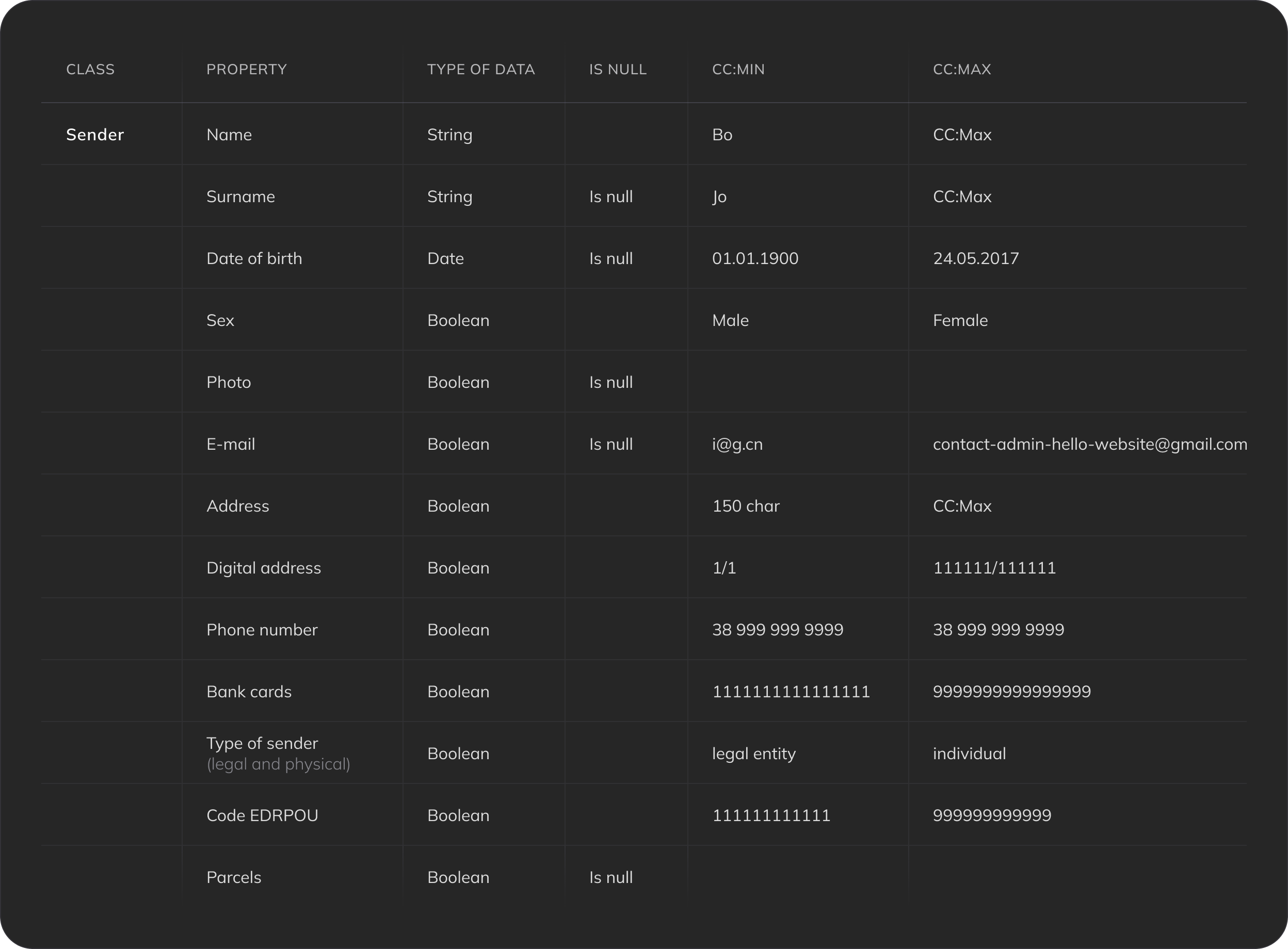
I structured the courier request experience using object-oriented design principles. This helped define reusable UI modules tied to real-world entities.
Below is an example of one of these roles: Courier, Parcel, Sender etc.
Business Process Model & Notation
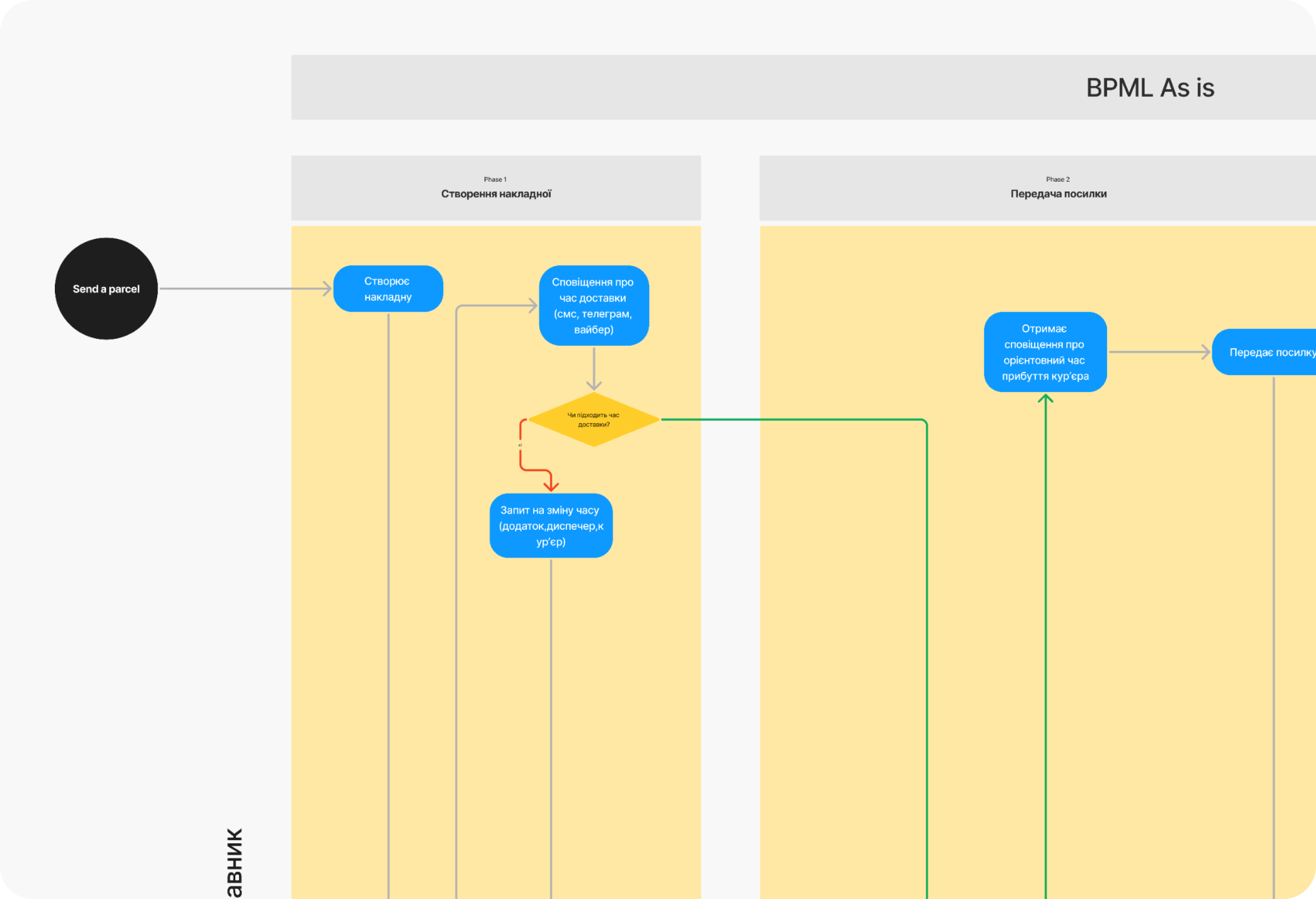
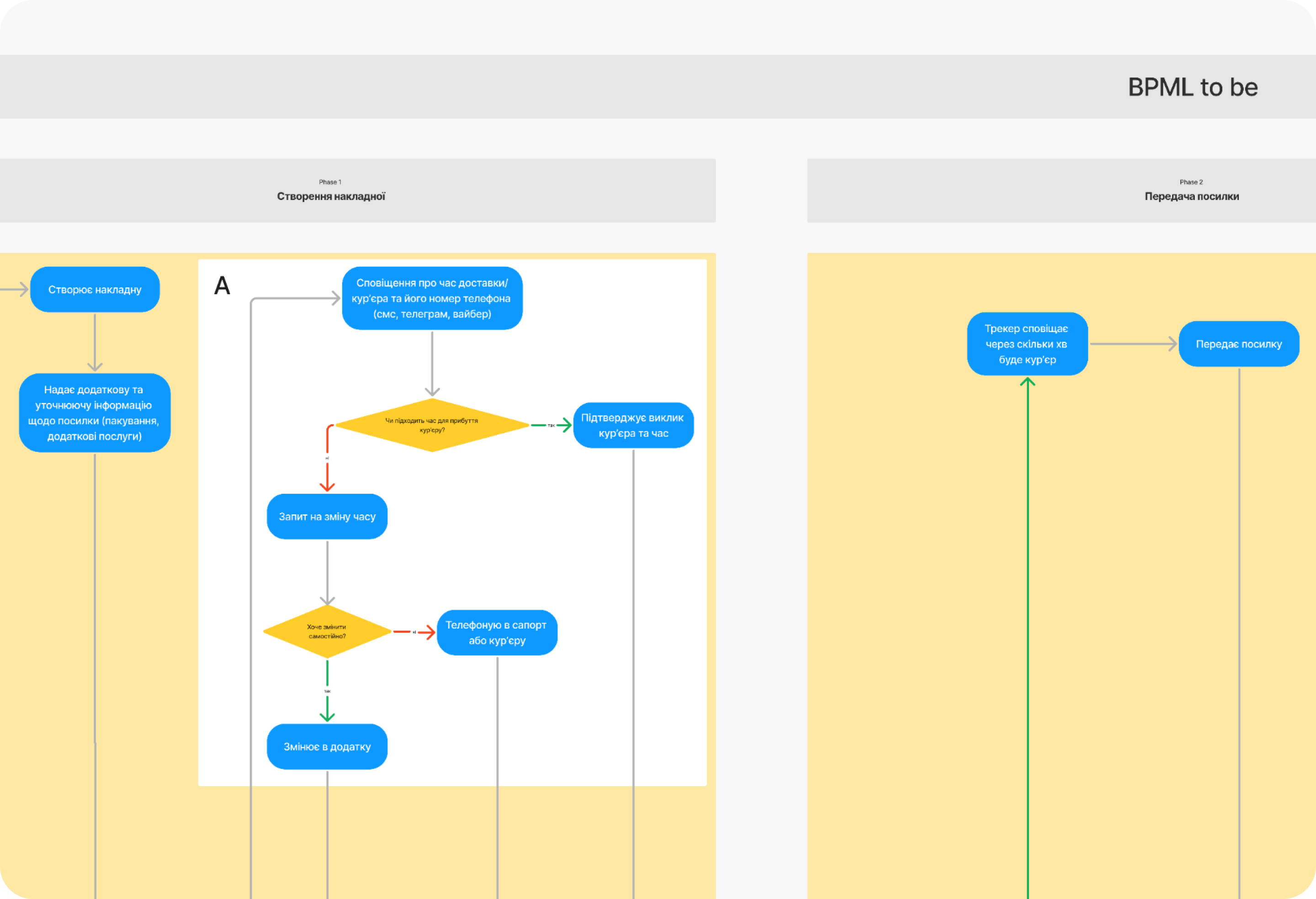
I conducted interviews with couriers, parcel senders, and internal stakeholders. I translated those findings into a Business Process Model and Notation (BPMN) flow to identify areas for optimisation:
Uncover operational bottlenecks
Align the product with logistics workflows
Reveal automation and notification touchpoints
Validate design feasibility with backend engineering
Simplifying Waybill Creation
Divided the waybill creation process into stages.
Added date and time selection for courier arrival.
Reorganised text fields for more consistent information filling.
Added the ability to save recipient/sender address.
Enabled address saving and package dimension selection.
Showed a description of additional services at once.
Removed irrelevant information (excluded the "Packaging" service from the "Additional Services" because it is available only at the branch).
Providing senders a time choice
Introduced the option for senders to choose a convenient delivery time when creating a waybill.
Enhancing Parcel Tracking
Provided a status preview for all delivery stages: request-courier-parcel with the ability to track the entire courier delivery process.
Added a separate status details page with the ability to see the delivery route on the map (the map will show the stages of delivery, not the actual location of the courier).
Improved Parcel Management
Added a floating "Parcel Management" button for easy access to actions.
Added the "Call courier" action to the parcel management actions.
Next to the status of the "You have been assigned a courier" stage, added the "Change time" button,
Added the courier's contacts and the "Call" button next to the "Courier is on his way to you" status.
Flexible Arrival Time Management
Added the ability to confirm "Convenient time" to the sender and select "Day of the week" in the time picker,
Offered the recipient to confirm or change the time selected by the system.
Outcome
In the next phase, we conducted user testing sessions where real users interacted with our prototypes. Feedback from these sessions was mainly positive, validating our design choices and highlighting the positive impact of our user-centric approach. Hypotheses 2 (Time choice for senders) and 4 (Enhanced Parcel Management) performed exceptionally well during testing.
Additionally, thanks to the tests, we gained insights that sparked ideas for improving our design solutions
Summary
During the final meeting with stakeholders, we presented developed hypotheses; summaries of user testing sessions and feedback; suggestions for potential future enhancements or iterations based on user feedback and evolving user needs.
The outcomes of our team's efforts were appreciated, some of the proposed solutions were adopted for implementation.
We firmly believe that the suggested alterations and enhancements will significantly enhance the user-friendliness of the application. This, in turn, is expected to boost the success rate of creating delivery notes, curtail the need for customer service calls, and enhance the overall efficiency of our courier services. Users will enjoy the convenience of tracking parcels, managing deliveries, and choose convenient delivery times.
How I enchanced Nova Poshta’s Book Courier flow App Experience
Challenge
Users couldn’t easily schedule, modify, or trust courier pickups via mobile. This resulted in drop-offs, support calls, and lost revenue.
Approach
Desk research, Object-Oriented UX, Business Process Model & Notation, hypothesis and prototype creation.
Outcome
Created a simple and clear process of calling a courier with the possibility of tracking both the courier and a package
Object-Oriented UX
I structured the courier request experience using object-oriented design principles. This helped define reusable UI modules tied to real-world entities.
Below is an example of one of these roles: Courier, Parcel, Sender etc.
Business Process Model & Notation
I conducted interviews with couriers, parcel senders, and internal stakeholders. I translated those findings into a Business Process Model and Notation (BPMN) flow to identify areas for optimisation:
Uncover operational bottlenecks
Align the product with logistics workflows
Reveal automation and notification touchpoints
Validate design feasibility with backend engineering
Simplifying Waybill Creation
Divided the waybill creation process into stages.
Added date and time selection for courier arrival.
Reorganised text fields for more consistent information filling.
Added the ability to save recipient/sender address.
Enabled address saving and package dimension selection.
Showed a description of additional services at once.
Removed irrelevant information (excluded the "Packaging" service from the "Additional Services" because it is available only at the branch).
Providing senders a time choice
Introduced the option for senders to choose a convenient delivery time when creating a waybill.
Enhancing Parcel Tracking
Provided a status preview for all delivery stages: request-courier-parcel with the ability to track the entire courier delivery process.
Added a separate status details page with the ability to see the delivery route on the map (the map will show the stages of delivery, not the actual location of the courier).
Improved Parcel Management
Added a floating "Parcel Management" button for easy access to actions.
Added the "Call courier" action to the parcel management actions.
Next to the status of the "You have been assigned a courier" stage, added the "Change time" button,
Added the courier's contacts and the "Call" button next to the "Courier is on his way to you" status.
Flexible Arrival Time Management
Added the ability to confirm "Convenient time" to the sender and select "Day of the week" in the time picker,
Offered the recipient to confirm or change the time selected by the system.
Outcome
In the next phase, we conducted user testing sessions where real users interacted with our prototypes. Feedback from these sessions was mainly positive, validating our design choices and highlighting the positive impact of our user-centric approach. Hypotheses 2 (Time choice for senders) and 4 (Enhanced Parcel Management) performed exceptionally well during testing.
Additionally, thanks to the tests, we gained insights that sparked ideas for improving our design solutions
Summary
During the final meeting with stakeholders, we presented developed hypotheses; summaries of user testing sessions and feedback; suggestions for potential future enhancements or iterations based on user feedback and evolving user needs.
The outcomes of our team's efforts were appreciated, some of the proposed solutions were adopted for implementation.
We firmly believe that the suggested alterations and enhancements will significantly enhance the user-friendliness of the application. This, in turn, is expected to boost the success rate of creating delivery notes, curtail the need for customer service calls, and enhance the overall efficiency of our courier services. Users will enjoy the convenience of tracking parcels, managing deliveries, and choose convenient delivery times.
How I enchanced Nova Poshta’s Book Courier flow App Experience
Challenge
Users couldn’t easily schedule, modify, or trust courier pickups via mobile. This resulted in drop-offs, support calls, and lost revenue.
Approach
Desk research, Object-Oriented UX, Business Process Model & Notation, hypothesis and prototype creation.
Outcome
Created a simple and clear process of calling a courier with the possibility of tracking both the courier and a package
Object-Oriented UX
I structured the courier request experience using object-oriented design principles. This helped define reusable UI modules tied to real-world entities.
Below is an example of one of these roles: Courier, Parcel, Sender etc.
Business Process Model & Notation
I conducted interviews with couriers, parcel senders, and internal stakeholders. I translated those findings into a Business Process Model and Notation (BPMN) flow to identify areas for optimisation:
Uncover operational bottlenecks
Align the product with logistics workflows
Reveal automation and notification touchpoints
Validate design feasibility with backend engineering
Simplifying Waybill Creation
Divided the waybill creation process into stages.
Added date and time selection for courier arrival.
Reorganised text fields for more consistent information filling.
Added the ability to save recipient/sender address.
Enabled address saving and package dimension selection.
Showed a description of additional services at once.
Removed irrelevant information (excluded the "Packaging" service from the "Additional Services" because it is available only at the branch).
Providing senders a time choice
Introduced the option for senders to choose a convenient delivery time when creating a waybill.
Enhancing Parcel Tracking
Provided a status preview for all delivery stages: request-courier-parcel with the ability to track the entire courier delivery process.
Added a separate status details page with the ability to see the delivery route on the map (the map will show the stages of delivery, not the actual location of the courier).
Improved Parcel Management
Added a floating "Parcel Management" button for easy access to actions.
Added the "Call courier" action to the parcel management actions.
Next to the status of the "You have been assigned a courier" stage, added the "Change time" button,
Added the courier's contacts and the "Call" button next to the "Courier is on his way to you" status.
Flexible Arrival Time Management
Added the ability to confirm "Convenient time" to the sender and select "Day of the week" in the time picker,
Offered the recipient to confirm or change the time selected by the system.
Outcome
In the next phase, we conducted user testing sessions where real users interacted with our prototypes. Feedback from these sessions was mainly positive, validating our design choices and highlighting the positive impact of our user-centric approach. Hypotheses 2 (Time choice for senders) and 4 (Enhanced Parcel Management) performed exceptionally well during testing.
Additionally, thanks to the tests, we gained insights that sparked ideas for improving our design solutions
Summary
During the final meeting with stakeholders, we presented developed hypotheses; summaries of user testing sessions and feedback; suggestions for potential future enhancements or iterations based on user feedback and evolving user needs.
The outcomes of our team's efforts were appreciated, some of the proposed solutions were adopted for implementation.
We firmly believe that the suggested alterations and enhancements will significantly enhance the user-friendliness of the application. This, in turn, is expected to boost the success rate of creating delivery notes, curtail the need for customer service calls, and enhance the overall efficiency of our courier services. Users will enjoy the convenience of tracking parcels, managing deliveries, and choose convenient delivery times.